
Expert Therapy for Suicidal Teens in Katy, TX
“You don’t know how it got to this point, but you do know you will do whatever it takes to help your teen and keep them safe.”
Your family has entered a crisis, and you are shook to your core. Suddenly, you are in a world filled with acronyms, medicine names you can hardly pronounce, and an overwhelming amount of information with no answers.
Maybe you discovered your teenager is self-harming or is having thoughts of suicide. Or maybe they attempted suicide, and you are unsure what to do once they return from the hospital.
You don’t know how it got to this point, but you do know that you will do whatever it takes to help your teen and keep them safe.
Suicidal Teen Expert in Katy, TX
You need someone who knows the mental health system in Katy, TX—someone who can answer your questions, advocate for you, and—most importantly—restore health to your family.
I have worked at every level of care in the Katy, TX, mental health system. I know all of the acronyms and jargon. I know how to help your family navigate a teen who is suicidal. My passion is working with families in crisis to bring restoration and healing.

Clients at the end of therapy with me often report:

What is a Teen Crisis?
When safety is at risk, it means there is a crisis that needs specialized help. In my practice, I specialize in navigating the complexities of:
Suicidal thoughts, self-harm, or recent attempts
Sudden or worsening psychosis (paranoia, disorganized behavior, or hearing/seeing things)
Acute trauma and safety-related behavioral issues
These crises do not affect just one person; they ripple through the entire family. They are scary, exhausting, and often leave you feeling powerless. This is where specialized, expert support is required to move from immediate danger toward long-term stability.

When to Seek Immediate Support for Teen Suicidal Thoughts
When you arrive at a mental health hospital, they will assess your teen, and a professional can advise you on whether or not inpatient care is necessary. However, if you are unsure whether or not inpatient care is necessary, here are some principles that can guide you.
This is not a substitute for a professional evaluation. If you or your teen is in an unsafe situation, call 911. A moment of calm immediately after a moment of crisis can be a warning sign that a decision has been made. Trust your gut as a parent. If something feels wrong, get help immediately.
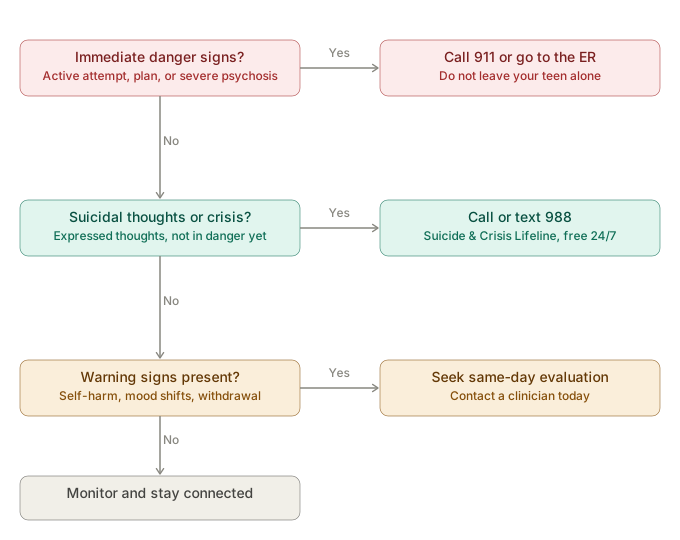
Call 911 or go to the nearest ER immediately if your teen:
- Is actively attempting suicide or has just made an attempt
- Has a specific plan and the means to carry it out
- Is threatening to harm someone else
- Is unconscious, unresponsive, or has ingested substances in a self-harm context
- Is severely psychotic — hearing voices commanding harm, completely disconnected from reality
- Has not eaten or slept in several days to the point of physical danger
Call or text 988 (Suicide & Crisis Lifeline) if your teen:
- Is expressing suicidal thoughts but is not in immediate danger
- Is in emotional crisis and you need guidance on next steps
- You’re unsure whether the situation requires an ER visit
- Suddenly gives away prized possessions or says goodbye to people
Seek urgent (same-day) evaluation if your teen:
- Has been self-harming and the behavior is escalating
- Has a dramatic, unexplained shift in mood — especially sudden calm after a period of severe depression
- Is refusing all food or water
- Is expressing hopelessness with statements like “everyone would be better off without me”
A moment of calm immediately after a moment of crisis can be a warning sign that a decision has been made. Trust your gut as a parent. If something feels wrong, get help.
Same Day Evaluations in Katy, TX
In an emergency, please call 911. In non-emergency situations, I pride myself on my quick response time. With me, you will always receive a response within 24 hours and can have an evaluation within one business day.
The Teen/Child's Biggest Strength
Adults in crisis often face their struggles alone. Children and teens, however, have a unique advantage: they have their family. This is their biggest strength. Family support is the most powerful part of recovery. Families provide:
- safety
- daily structure
- emotional connection
- guidance.
This is true for all families whether they are biological, blended, adoptive, or chosen.
My Family-Centered Approach to Adolescent Crisis Treatment
Because of this, I take a family-centered approach to crisis treatment. I always involve parents or caregivers, not because anyone is to blame, but because crises require everyone working together.
Many parents worry they will be judged or blamed. Some fear coming to therapy will feel like being “called to the principal’s office.” That is not what happens here. Crisis therapy is about connection, collaboration, and finding steadiness, not assigning fault.
Every situation is different. While I am family-centered, I am flexible and tailor my approach to best suit each family. Sessions with me be spent
As a Full Family Unit: To build communication, safety plans, and mutual understanding.
With the Teen Individually: To provide a private space for processing and skill-building.
With Parents Alone: To offer coaching, support, and a space to discuss the logistics of care without the teen present.
What Will Therapy Look Like?
I customize my approach to best suit each client I work with, so no two experiences with me will be the same. However, therapy with me generally follows this pattern:
Phase 1: Stabilization
Safety is the number one priority. I use skill building, safety planning, resource building, and environmental management to create an environment of stabilization and safety.
Phase 2: Comprehensive Assessment
Once the immediate danger is managed, we take 2-3 sessions to build a deep understanding of the situation. I look at the teen’s history, family dynamics, and clinical symptoms to build a personalized roadmap for long-term health.
Phase 3: Active Growth/ Goal Work
With a clear understanding of the situation, a custom plan is used to work towards your goals.
Phase 4: Resilience and Maintenance
Once goals are achieved, we ensure progress is maintained and create a plan for concluding therapy
Common Questions From Parents
How Quickly Can we Start?
I prioritize high-acuity cases and strive to see new families for a consultation within 1 business day. If I am completely full, I will provide you with trusted referrals who specialize in crisis work so your teen doesn’t have to wait for help.
Do you work with teens who are currently in the hospital?
Yes. I often begin working with families during the discharge planning phase. Having a specialized therapist ready to go the moment a teen leaves a hospital or residential program is one of the most effective ways to prevent a relapse or re-hospitalization.
Will you tell me what my teen says in their private sessions?
I maintain a balance of clinical privacy and physical safety. While the teen needs a private space to be honest, I am clear from day one: Safety is not a secret. If there is an immediate risk to your teen’s life or the life of others, parents are involved immediately. My family-centered approach ensures you are never left in the dark regarding safety.
Can you coordinate with my teen's psychiatrist or school?
Absolutely. Part of my role as your ‘guide’ through the mental health system is ensuring all providers are on the same page. With your permission, I regularly consult with psychiatrists, school counselors, and medical doctors to ensure a comprehensive approach to your teen’s care.
What if my teen refuses to come to therapy?
This is more common than you might think. Because I use a family-systems approach, we can often begin the work with just the parents. By changing the environment and the way the family responds to the crisis, we can often lower the teen’s resistance and eventually bring them into the process.